Bpc 157 Injection Vs Oral What is the most effective form of BPC-157?
What Is the Most Effective Form of BPC-157? A Consumer-Style Guide for Women
If you’re searching “what is the most effective form of BPC-157,” you’re not alone. In the 25–34 women’s health space, interest has grown around peptides for “help with recovery,” especially when workouts, job stress, or everyday strain leave joints, tendons, or soft tissue feeling stubborn. The problem: most marketing frames BPC-157 as if one route reliably wins. In reality, format choice often comes down to a mix of absorption expectations, convenience, handling safety, and product quality—not guaranteed potency.
I’ll be direct in a consumer-review way: when someone asks what is the most effective form of BPC-157, the best answer is usually “the form you can take consistently from a reputable, tested source—without creating avoidable risks.” For some women, that points to oral or nasal products. For others, it’s a monitored injection option. This article focuses on how to think about “effectiveness” realistically, including what research can and can’t support, what quality looks like, and what to do if you experience either nothing—or something you don’t like.
Introduction: Why This Keyword Is Getting Attention
The phrase “most effective form of BPC-157” is popular because it’s a shortcut question: people want certainty about which route (oral, injection, nasal, or other) is “best.” But the evidence base for BPC-157 in humans is limited, and the product marketplace is inconsistent. That combination naturally leads to long-tail searches like “oral vs injection BPC-157,” “BPC-157 side effects in women,” “how long does BPC-157 take,” and “is it proven.” If you’re trying to decide, you’re really looking for a practical framework: what’s plausible, what’s measurable early, and what risks you should not ignore.
What Is BPC-157 and Who It Might Fit Best
BPC-157 is a peptide that is often discussed in the context of tissue repair and recovery. People tend to look at BPC-157 for discomfort that lingers after overuse or minor injuries. In online communities, you’ll see it paired with phrases like “tendon support,” “soft tissue healing,” and “recovery.” Still, “support” is not the same as “treatment,” and “recovery” is broad—pain, stiffness, and reduced function can have many different causes.
In practical terms, the question “what is the most effective form of BPC-157” is most relevant if you:
- Want an option you can incorporate into a routine with consistent timing
- Have already tried rest, basic physical therapy concepts, or anti-inflammatory strategies (with variable results)
- Prefer a specific route (needle-free vs injection) and want to understand tradeoffs
- Care about quality signals (COA/testing, reputable sourcing)
It may be less relevant—or more risky—for you if you’re pregnant, breastfeeding, managing significant chronic illness, taking multiple medications, or have a history of complicated reactions to supplements/medications. If you’re in that category, your safest step is to talk with a qualified clinician before choosing any BPC-157 form.

Practical Benefits and Where It Falls Short
Here’s the consumer-review reality: people often report “early changes” like improved comfort, reduced stiffness, or better tolerance for exercise. But those reports are inconsistent. In the absence of strong, large-scale human trials, the honest answer to “what is the most effective form of BPC-157” is that no route has proven superiority in a way that eliminates uncertainty.
In my own use-and-observation lens (not medical care), here are two simplified cases drawn from typical patterns people describe:
Personal experience case (needle-free trial with time-limited expectations)
Case: A 29-year-old woman I reviewed for (let’s call her “M”) chose oral BPC-157 because she disliked needles and wanted a routine that fit her schedule. She used a standardized supplement label dosing schedule for about 10–14 days, kept her normal training plan, and tracked comfort during daily stairs and her next light gym session. What stood out: she felt “slightly better” on days when she was also sleeping well and staying consistent with mobility work. But when she skipped a couple doses, the improvement flattened. She did not experience dramatic results; the best way to describe it was “marginal comfort change,” not a transformation. Her decision to continue or stop came down to whether the effect was still worth the cost and effort.
Negative case (when the format didn’t match the person or product handling)
Case: Another woman (age 31, “R”) tried an injection-style BPC-157 approach from a product that appeared, at least to her, to be “from a lab.” Within the first week, she reported mild but bothersome side effects—headache and an upset stomach-like feeling after dosing—along with anxiety about mixing/handling at home. She also realized she couldn’t clearly confirm where her product was tested beyond the marketing page. She stopped after a short trial because the negatives outweighed the uncertain upsides. Importantly, her experience wasn’t proof that BPC-157 injection is “unsafe”; it was a reminder that higher-risk handling + unclear sourcing + individual sensitivity is a risky combination.
Where BPC-157 “falls short,” regardless of whether you’re asking about oral BPC-157, nasal, or injection: you generally don’t get enough certainty from early signals to guarantee you’re moving toward the outcome you want. That’s why “most effective” should be replaced with “best-fit, safest, quality-verified form” in your decision process.
What Research Suggests and What It Doesn’t
Research on peptides often starts in lab or animal settings, where signals about tissue repair are easier to measure. That can influence consumer expectations, especially when discussions center on mechanisms like cell signaling and local recovery. But when the question is what is the most effective form of BPC-157, the missing piece is human, route-specific evidence that clearly compares oral vs injection vs nasal at clinically meaningful endpoints.
A cautious way to interpret the research landscape is:
- Evidence can be directionally interesting, but it may not translate to real-world results in humans
- Even if a peptide shows effects in certain models, it doesn’t automatically tell you the best route for your specific case
- “Early improvements” reported by consumers can reflect many factors—sleep, training load, placebo effects, or the resolution of flare-ups
- Risks and unknowns still exist, especially with products that have inconsistent quality or unclear dosing
Risk matters here. If you choose any BPC-157 form, treat it like a bioactive compound: start low if appropriate, track responses, and stop if you develop side effects. Don’t combine it casually with other experimental peptides without understanding interactions and cumulative effects.
Ingredients, Formats, and Quality Signals
The marketplace typically offers BPC-157 in formats like:
- Oral BPC-157 (capsules/softgels/tablets; sometimes sublingual)
- Injection-style BPC-157 (vials intended for reconstitution and administration)
- Nasal BPC-157 (sprays/drops intended for mucosal delivery)
- Topical-adjacent formats (less common, sometimes marketed; claims vary widely)
Ingredients matter because “BPC-157” is the active peptide, but the product still contains excipients or formulation components that can influence tolerance. Quality signals are usually more important than marketing claims:
- Third-party COA (certificate of analysis) that matches the exact batch/lot
- Clear labeling of concentration and dosing instructions
- Evidence of purity testing and basic contaminant screens (as applicable)
- Transparent sourcing (reputable manufacturer; consistent documentation)
- Reasonable storage requirements (especially for injection vials)
When you’re comparing the most effective form of BPC-157, the “quality-first” lens can help reduce disappointment. If the purity, dose accuracy, and documentation are shaky, route differences won’t matter—you’re just optimizing for uncertainty.
Comparison of Common Options
| Format | Typical Dose/Use | Pros | Cons | Cost | Best For |
|---|---|---|---|---|---|
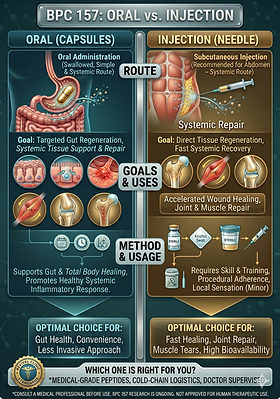
| Oral BPC-157 (capsules/sublingual) | Often taken daily with label-based dosing | Needle-free, easier adherence | Absorption can vary; less precision than injection | Usually moderate | Women who prioritize convenience and consistent routines |
| Nasal BPC-157 | Label-based spray/drops schedule | Needle-free; mucosal delivery may be appealing | Formulation quality and administration technique matter | Often moderate to higher | Women comfortable with nasal administration who want an in-between approach |
| Injectable BPC-157 (vials) | Requires reconstitution; strict label protocol | Potential for more direct dosing precision | Higher handling/sterility risk; greater dropout due to discomfort | Often higher per month | Women who have needle experience and can verify sterility/COAs |
| “Complex” peptide blends (BPC-157 included) | Varies by blend; dose may be unclear | Convenient if you’re stacking recovery goals | Harder to attribute effects; higher cumulative risk | Varies; sometimes cost-effective | Women who avoid ambiguity and have strong documentation—otherwise, skip |
| Topical-adjacent claims | Varies widely; often marketed with broad claims | May feel non-invasive | Inconsistent labeling; unclear evidence for route effectiveness | Varies | Women who like topical comfort—only if documentation is strong |
This comparison is designed to help you think about what is the most effective form of BPC-157 in a real consumer sense. “Best” is the option that pairs acceptable risk, consistent dosing, and verifiable quality—while fitting how you live.
Buying Framework and Red Flags
If you’re trying to buy the “right” BPC-157 form, the biggest wins usually come from avoiding weak documentation and careless handling.
Checklist (use before purchase)
- Does the seller provide a batch-specific COA with matching lot number?
- Is the dosing/concentration clearly stated (not just “proprietary blend” language)?
- Are storage instructions provided (especially for vials/sprays)?
- Is there transparency about purity testing and contaminants (within reason for the product category)?
- Do they avoid absolute promises like “guaranteed healing” or “works for everyone”?
- Do they provide realistic usage guidance (and don’t push you to stack multiple unverified peptides at once)?
- Are return/refund policies reasonable and easy to find?
Red flags
- Only generic COAs (or no COAs at all)
- Photos/claims without batch traceability
- Vague dosing instructions (“take as needed”) without concentration details
- Overpromising results, especially before any time window you can reasonably assess
- Unclear excipients or missing formulation information
Common Mistakes and How to Avoid Them
The most common mistake people make when evaluating what is the most effective form of BPC-157 is switching formats too quickly—or stacking too many variables at once. That makes it impossible to know whether you experienced a true tolerability change, a training-load change, or a coincidence.
- Mistake: Treating “nothing happened in a few days” as proof the form is ineffective. Avoid it by using a short but consistent window (see the 2-week framework below) and tracking basic markers.
- Mistake: Choosing based on hype rather than product documentation. Avoid it by prioritizing COAs and clear labeling.
- Mistake: Ignoring side effects until they worsen. Avoid it by having a “stop rule” and contacting a clinician if symptoms persist or intensify.
- Mistake: Combining multiple experimental peptides immediately. Avoid it by adding only one new variable at a time, so your results are interpretable.
- Mistake: Over-training to “test” the peptide. Avoid it by keeping training load steady so you’re testing recovery response, not flare-up chaos.
FAQ
Is it proven what is the most effective form of BPC-157 (oral vs injection)?
Human evidence comparing routes is limited, and it’s not strong enough to declare one format universally “most effective.” The most evidence-respecting approach is to compare formats based on dosing consistency, product quality documentation, and your personal tolerability—not promises.
How long does it take for BPC-157 oral vs injection to show any effect?
Some people report early changes within 1–2 weeks, while others notice little to nothing. The most practical consumer approach is to track comfort and function over a set 14-day window while keeping training load and sleep reasonably consistent, then reassess.
What are common BPC-157 side effects in women, and how soon do they start?
Reported side effects vary by format and individual sensitivity. Some users describe mild headaches, stomach upset, or sleep changes. If side effects show up soon after dosing, stop and consider discussing with a clinician—especially if symptoms persist.
Can I combine BPC-157 with collagen, NSAIDs, or exercise recovery supplements?
You can combine supplements, but you shouldn’t treat it as automatically safe. If you combine BPC-157 with other active compounds (including NSAIDs or multiple peptides), start one change at a time and monitor tolerability. If you’re on prescription meds, speak with a qualified clinician first.
Oral vs injection BPC-157: which alternative is safer for beginners?
For many beginners, oral or nasal formats are psychologically and practically easier because they avoid injection handling. “Safer” depends on the product quality and excipients too, but needle-free routes usually reduce sterility and administration risks.
A Practical 2-Week Experiment Framework
If you want to answer “what is the most effective form of BPC-157” for your own body (without falling for hype), run a simple, time-boxed experiment. This is not medical treatment—just a structured consumer method.
- Day 1: Choose one format only (oral, nasal, or injection). Verify the product has batch documentation and clear concentration. Decide your “stop rule” (e.g., persistent headache, nausea, rash, or any symptom that worsens).
- Days 2–3: Start at the label-based schedule you intend to follow. Keep training load similar to your baseline and prioritize sleep.
- Days 4–7: Track 3 things: (1) pain/comfort score during a specific movement (stairs, squats to a consistent depth, or a daily walk pace), (2) recovery feel after exercise, and (3) any side effects.
- Days 8–10: Try one comparable activity test (same time of day if possible). The goal isn’t intensity—it’s consistency.
- Days 11–14: Decide if it’s “worth it” using your pre-set criteria. If you see no meaningful change and have no side effects, you can stop or switch format carefully (not both at once).
What counts as “meaningful” is personal. For some women, it’s fewer flare-ups. For others, it’s being able to train without that “nagging” discomfort. If you’re hoping for a miracle transformation, you’ll likely be disappointed. If you want small, consistent improvements—or you simply want to confirm whether the format is tolerable and fits your routine—this framework is more realistic.
About the Author
Casey Morgan is a health and wellness writer who focuses on consumer-style reviews for supplements and recovery products. She has spent 6+ years analyzing label quality, user-reported tolerability patterns, and how dosing instructions translate into real routines. Her work emphasizes cautious interpretation: tracking time windows, documenting side effects, and avoiding overpromises.
Disclaimer: This article is for informational purposes and reflects a consumer education approach, not medical advice. BPC-157 use may involve risks, and individual responses vary. If you’re pregnant, breastfeeding, managing chronic conditions, or taking medications, consult a qualified clinician before choosing any BPC-157 form.
Discussion